
Panaflex is the default for most stalls in Pakistan, but fabric, vinyl, backlit media and acrylic each solve a different problem — glare, reuse, lighting, finish. This guide compares them using manufacturers' data sheets, then covers the artwork file specs printers ask for.
Quick answer: Panaflex vs fabric printing: panaflex (PVC flex) is the usual choice for one-off shows, outdoor banners and tight budgets; it is tough but can shine under stall lights. Printed fabric is matte, lighter and folds for reuse, making it better for premium or repeat stalls, often stretched in silicone-edge (SEG) frames. Use backlit media for light boxes, self-adhesive vinyl for flat walls and counters, and acrylic for logos and signs.
The five materials at a glance
| Material | What it is | Best for | Watch out for |
|---|---|---|---|
| Panaflex (frontlit flex) | PVC-coated or laminated polyester banner | Backdrops, stall walls, outdoor banners, one-off shows | Glare under spotlights, creasing, fire rating varies by product |
| Backlit flex or backlit fabric | Translucent media made to be lit from behind (e.g. a 120 gsm polyester backlit fabric rated DIN 4102-1 B1 and NFPA 701, per Ball & Doggett) | Light boxes, lit logos and walls | Needs different printing from frontlit; test with the actual light |
| Printed fabric (incl. SEG) | Polyester fabric, usually dye-sublimation printed | Premium stalls, reusable frames, curved shapes | Cannot be wiped clean, needs careful handling and storage |
| Self-adhesive vinyl | Printable adhesive film applied to a surface | Counters, flat walls, shell scheme panels, glass | Needs a smooth flat surface; check which adhesive the venue allows |
| Acrylic | Rigid clear or coloured plastic sheet | Logos, signs, counter fronts, display stands | Rigid and must be packed carefully for transport |
Panaflex (PVC flex): frontlit and backlit
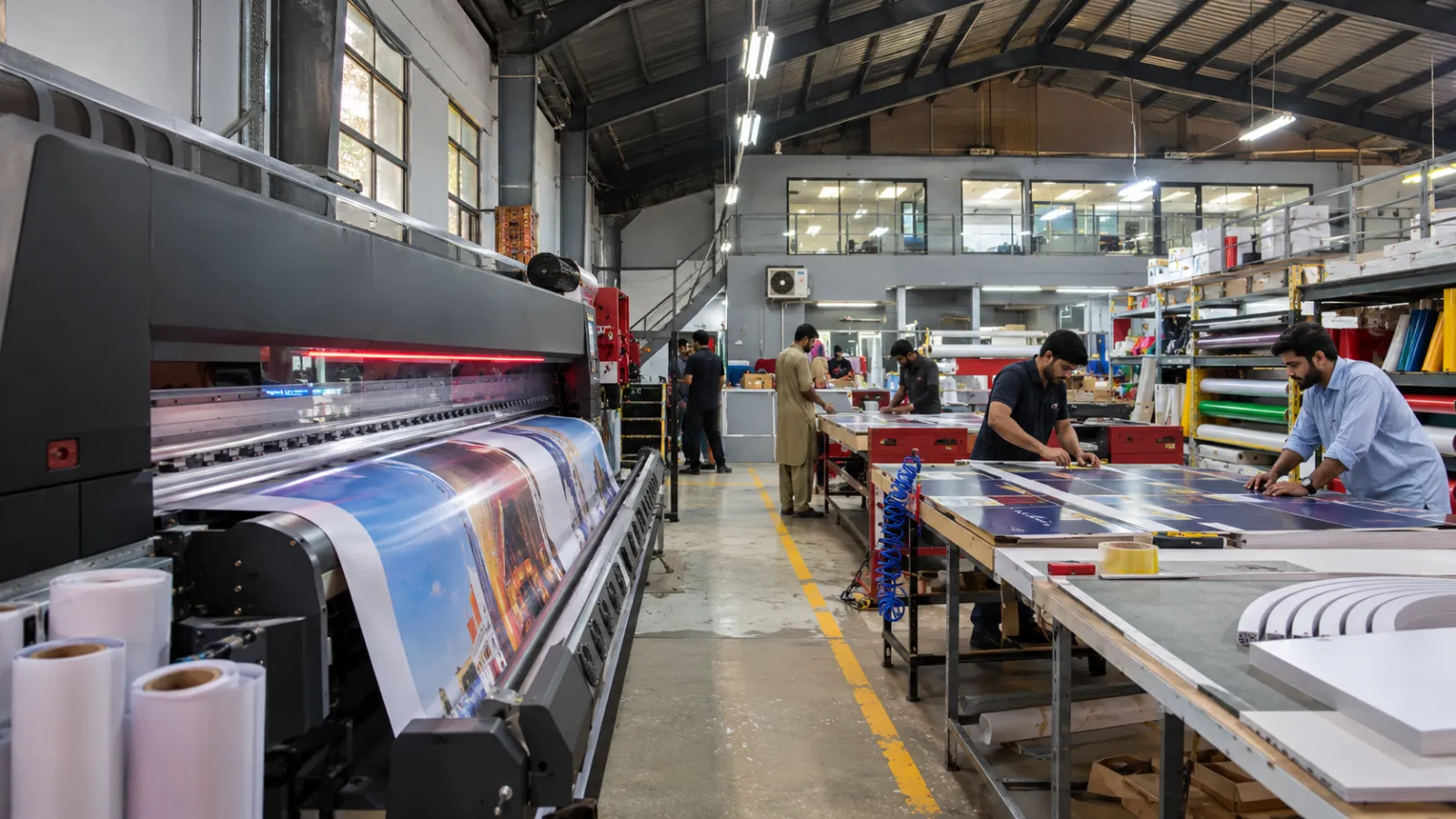
"Panaflex" is the everyday Pakistani name for PVC flex banner — polyester fabric coated or laminated with PVC. Not all flex is the same, as manufacturers' data sheets show:
- Weight, construction and use: a 440 gsm laminated frontlit banner (eTEC, Paper.co.uk data sheet; 55 gsm fabric plus 385 gsm PVC) is specified for indoor banners and short-term outdoor event banners. A 510 gsm coated frontlit banner (Soyang PL2-510) is specified for long-term outdoor billboards and banners, with a much heavier 1000 x 1000 denier polyester base. Ask which construction your printer stocks and recommends.
- Fire rating: the same two sheets differ completely — the 440 gsm laminated product lists no fire rating, while the Soyang 510 gsm product lists DIN 4102-1 B1, NFPA 701 and M2. If your organiser asks for fire-retardant materials, get the exact media's data sheet.
Backlit flex
Backlit flex is made for light boxes. One manufacturer's 510 gsm backlit flex data sheet (Sign-in Global) describes a "bluish white translucent" substrate with translucency of more than 30%, for backlit boxes and billboards. Backlit graphics are printed differently, so tell your printer before the file is printed.
Where panaflex shines (and where it doesn't): LexJet, a US print-media supplier, says vinyl banner is cheaper and a top choice for temporary, one-time-use event graphics. The downside indoors is glare: a fabric printer's comparison (4over4) notes that vinyl-type banners can shine under bright booth lighting and can crease, which shows up badly on a large flat stall wall.
Printed fabric and SEG frames
Fabric graphics are usually dye-sublimation printed polyester. The most common exhibition use is the silicone edge graphic (SEG): according to PRINTING United Alliance, a printed fabric with silicone beading along its edges that pushes into the channel of a frame extrusion, holding it taut with a clean, edge-to-edge look.
- Matte finish: fabric does not throw back spotlight glare the way glossy PVC can, which helps in photos and video.
- Lighter and folds: Exhibitor magazine notes that fabric is light and easy to handle, and that seamless fabric can be produced in widths up to 10 feet. It can also wrap curves and unusual shapes better than rigid or heavy materials (LexJet).
- Reuse: SEG graphics pull out, so the frame can carry new graphics next show.
The trade-offs: fabric cannot be wiped like PVC. Exhibitor magazine advises clean gloves for installers, never laying fabric on the floor and storing it somewhere cool and dry. PRINTING United Alliance recommends folding SEG graphics print-side in, storing them in a sealed plastic bag and spot-cleaning with a damp white cloth.
An SEG graphic only fits a frame with the matching channel, so plan fabric and frame together at the stall design stage.
Self-adhesive vinyl
Self-adhesive vinyl is printed film that sticks to a surface — counters, flat wall panels, glass and doors. Avery Dennison's MPI 3000 series, a widely used example, is a white monomeric calendered vinyl (95 micron face film) that the manufacturer recommends for short-term promotional applications on flat substrates. It comes with either a permanent or a removable adhesive, in gloss or matt.
That choice matters on a shell scheme: many organisers restrict what you can fix to shell walls, so check whether adhesive graphics are allowed and whether removable adhesive is required. Our guide to shell scheme vs raw space covers the wider shell rules.
Acrylic signs and panels
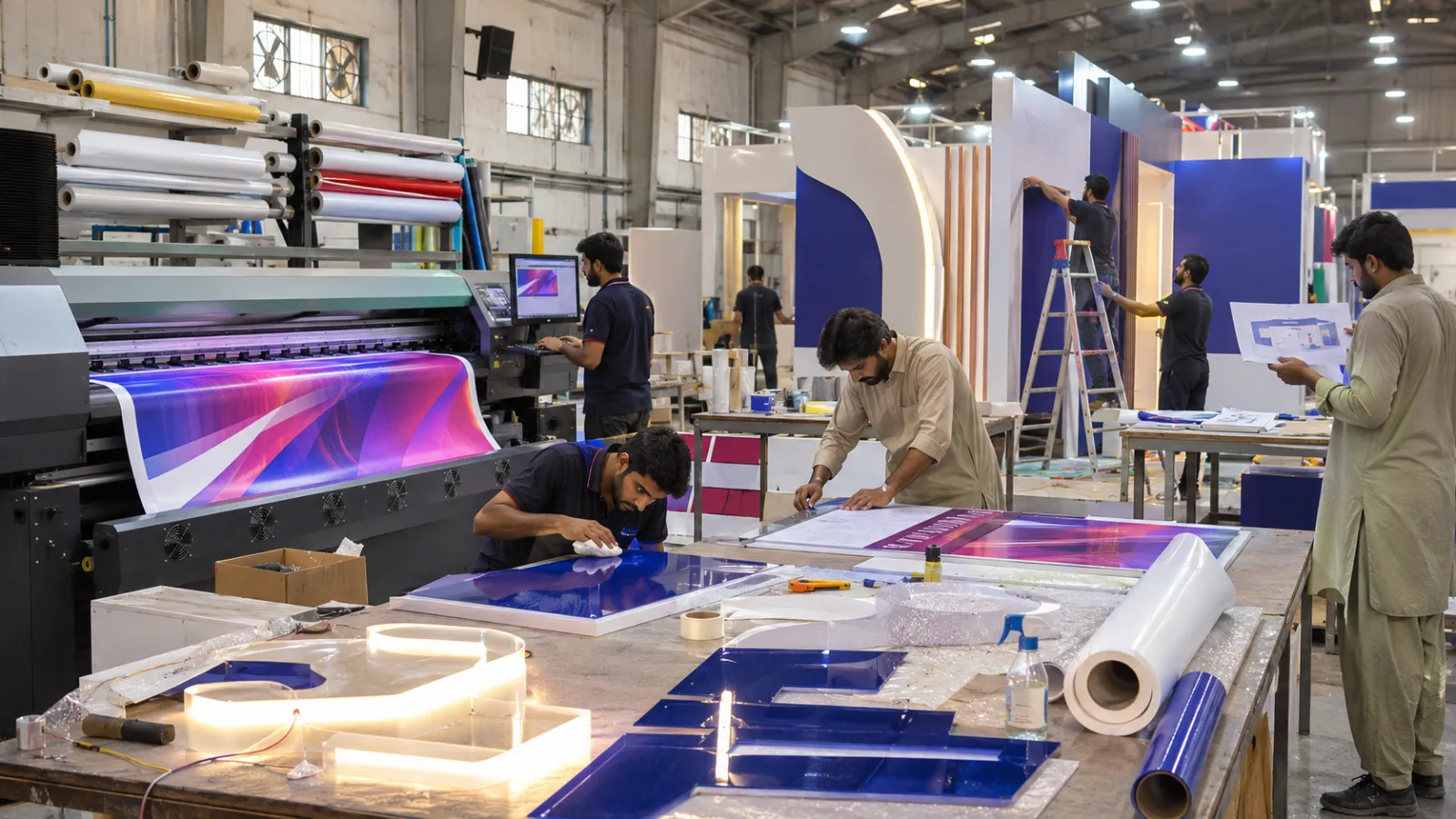
Acrylic is the rigid option for logos, reception signs, counter fronts and display stands. Clear cast acrylic is very transparent — PERSPEX states light transmission in excess of 92% for its clear cast sheet — which is why it is popular for lit logos and edge-lit signs. It is often combined with other materials, such as cut acrylic letters on a printed wall. Plan how each rigid piece will be packed, transported and fixed.
Panaflex vs fabric: which should you use?
Choose panaflex if…
- It is a one-off show and the graphics will not be reused.
- The banner goes outdoors or near an entrance.
- You need large backdrops quickly on a tight budget.
- The stall lighting is soft and glare is not a concern.
Choose fabric if…
- You exhibit regularly and want frames you can reuse.
- The stall is lit by strong spotlights or will be filmed.
- You want a premium, seamless, matte finish.
- The design includes curves or unusual shapes.
- Transport weight and storage space matter.
Most stalls mix materials: fabric or flex for walls, vinyl on the counter, acrylic for the logo, backlit media for light. The exhibition printing and signage page explains what we print, and if you are still weighing printed graphics against screens, see LED screen vs printed backdrop.
Artwork file specs printers ask for
Printers' published specs differ, as the figures below show — so always ask yours:
| Spec | What the guidance says |
|---|---|
| Size and scale | Build the file at final print size, or at a stated scale. Freeman's guide notes that scaled files need proportionally higher resolution — for example 1:10 artwork needs 1,000 dpi or more to equal 100 dpi at full size. |
| Resolution | HP suggests 100–150 PPI for trade show graphics viewed from 1.5–3 m and 50–100 PPI for outdoor banners viewed from 6 m or more, and warns against defaulting to 300 PPI for everything. GES's exhibit guideline asks for at least 100 dpi at full size and no more than 200 dpi. |
| Bleed | Varies by product: HP gives 3–6 mm beyond trim as a general large-format figure, while GES and Freeman ask for 1 inch on all sides for their exhibit graphics. Confirm with your printer. |
| Colour | Supply CMYK unless your printer asks otherwise (HP, Freeman). Give Pantone (PMS) references for logo colours that must match (GES, Freeman). |
| Fonts and logos | Convert fonts to outlines (GES, Freeman) and use vector logos (Freeman). Turn off overprint on white elements so they do not drop out (Freeman). |
| File format | Print-ready PDF — HP and Freeman recommend PDF/X-4 — with all images embedded. TIFF is an option for photographic images. |
| Safe area | Keep text and logos away from trim edges, frame channels and stitch lines (Instantprint). |
Name each file clearly — GES, for example, asks for the company name, booth, option and panel letter in every file name.
Common print mistakes to avoid
- Designing in RGB. Bright screen colours can shift in CMYK; check a printed proof.
- Text in the danger zone. Copy near the edge can disappear into an SEG channel, hem or fold.
- Wrong panel sizes. Shell and frame sizes vary — get the panel dimensions before artwork starts.
- Ignoring the lighting. A graphic can wash out under spotlights or look dark in a light box. Exhibitor magazine recommends testing the material under the chosen lighting.
Questions to ask your printer
- Which exact media will you use, and can you share its data sheet, including the fire rating?
- What bleed, safe area, resolution and file format do you need for this job?
- Will you send a colour proof of the logo and key colours before the full print?
- How will each graphic be finished — eyelets, pockets, hems, silicone edge or mounting?
- For fabric, how should it be folded, transported and stored for the next show?
- For vinyl, is the adhesive permanent or removable, and is it suitable for the surface?
- Who installs and removes the graphics at the venue?
Get advice on materials and file specs
Send your stall size, panel sizes and the show date. We will reply on WhatsApp with material options and the file specs we need. Call or WhatsApp 0326 9443049, email hello@6gridstudios.com, or visit our Gulberg III office.
FAQs
Is panaflex the same as flex printing?
Yes. Panaflex is the common Pakistani name for PVC flex banner, a polyester fabric coated or laminated with PVC. It comes in frontlit versions for normal lighting and backlit versions for light boxes, in different weights and grades.
Which is better for an exhibition stall, panaflex or fabric?
Panaflex suits one-off shows, outdoor use and tight budgets. Fabric suits premium or repeat stalls because it is matte, lighter and can be folded and reused in SEG frames. Many stalls use both, choosing by wall, lighting and reuse.
What resolution should exhibition print files be?
At full print size, guidance for trade show graphics is typically around 100 to 150 PPI for graphics seen from 1.5 to 3 metres, and lower for banners seen from far away. Very high resolution slows processing without visible gain. Always follow your printer's spec sheet.
How much bleed should I add to a banner or stall graphic?
It depends on the product and printer. General large-format guidance gives 3 to 6 mm, while some exhibition contractors ask for 1 inch on all sides for frame graphics. Ask your printer before you start the artwork.
Is panaflex fire-retardant?
Not always. Manufacturers' data sheets show some flex products with fire ratings such as DIN 4102-1 B1 or NFPA 701, and others with none. If your organiser requires fire-retardant materials, ask your printer for the data sheet of the exact media.
Can I stick vinyl graphics on shell scheme walls?
Only if the organiser allows it. Many shows restrict what can be fixed to shell panels. Check the exhibitor manual or ask the organiser, and if adhesive graphics are allowed, ask whether a removable adhesive vinyl is required.